

 Türkçe
Solutions
It will make your business stand out in the digital world...

CARGO & LOGISTICS INTEGRATION PACKAGE
CARGO AND LOGISTICS INTEGRATIONS PACKAGE End-to-end integration with 15+ cargo companies via SAP Integration Suite & PI/PO Short Description Our Cargo and Logistics Integrations Package enables the entire process, from receiving the order to barcode/label creation, transfer to the cargo company, distribution, delivery tracking and reporting, to be managed centrally through SAP Integration Suite or SAP PI/PO. By integrating with more than 15 cargo companies including MNG, Horoz, Kolay Gelsin and Hepsijet, processes become traceable and manageable from a single point. Solution Overview This solution is designed to manage the data flow between different order channels and cargo companies through a single integration layer. The Integration Suite & PI/PO structure at the center provides orchestration between order channels, warehouse/ERP/SAP systems, cargo operations, carrier companies and delivery processes. In this way, instead of running separate manual operations for each cargo company, a centralized and scalable integration structure is established. Process Flow Stage Description Order Received Order data from e-commerce, mobile application or store order channels is received by the integration layer. Label / Barcode Label and barcode information required for the shipment is generated; the cargo operation is standardized. Transfer to Cargo Company The order is routed to the appropriate carrier. Connections can be established with more than 15 cargo companies including MNG, Horoz, Kolay Gelsin and Hepsijet. Distribution Process Cargo dispatch and distribution movements are synchronized between systems. Tracking & Delivery Delivery status, shipment information and customer notification processes are handled in an integrated way. Reporting & Reconciliation Delivery performance, process efficiency and operational success become analyzable. Main Components Shown in the Visual Order Channels: Ensures that requests from e-commerce, mobile application and store orders are transferred into the central structure. Cargo Operations: Covers basic logistics steps such as barcode, labeling and shipment creation. Cargo Companies: Provides connection and management with multiple carriers from a single center. Tracking & Delivery: Supports monitoring of cargo status, delivery tracking and customer notification processes. Warehouse / ERP / SAP: Creates alignment with back-office processes by enabling order and stock synchronization. Reporting & Reconciliation: Provides performance, delivery success and analysis-oriented visibility. Benefits Provided Helps establish integration with more than 15 cargo companies from a single center. Supports end-to-end management of the entire logistics flow from order to delivery. Makes the delivery process more visible with real-time tracking. Reduces manual operational workload and contributes to standardized and sustainable processes. Increases operational efficiency through reporting and analytics capability.

PAYMENT & COLLECTION INTEGRATION PACKAGE
PAYMENT AND COLLECTION INTEGRATIONS PACKAGE Integration of payment services and collection processes with SAP Integration Suite & PI/PO Solution Overview This solution is designed as a structure that integrates the different services used by organizations in payment receiving and collection processes with SAP systems. Virtual POS, payment institutions, credit card transactions, alternative payment methods, bank services, invoice/collection tracking processes, and accounting records can be centrally managed through SAP Integration Suite & PI/PO. The structure shown in the visual presents the flow from the customer initiating the payment to collection approval, transmission to banks, accounting records, and reconciliation reporting in a simplified way. In this way, the process becomes not only a technical data transfer, but also a traceable, secure, and operationally manageable financial integration model. Integration Scope Area Scope Benefit Payment Services Virtual POS, payment institutions, credit card and alternative payment methods. Payment transactions progress faster, more securely, and more traceably. E-Commerce & Mobile Channels Web store, mobile application, and marketplace payment flows. Central tracking of payment data across different sales channels. Banks Bank integrations, money transfer/EFT, account movements, IBAN, and POS transactions. Standardized financial data exchange with banks. Collection Processes Invoice creation, collection planning, debit/credit tracking, reminder, and approval processes. More visible and controlled management of collection operations. ERP / SAP SAP & ERP integration, master data management, process and data synchronization. Financial data works in alignment with central systems. Accounting & Finance Accounting records, income/expense transactions, budget and financial management, tax/legal compliance. Consistent data usage in accounting and reporting processes. Reconciliation & Reporting Automatic reconciliation, detailed reports, dashboards, and analysis outputs. Reduced need for manual control and faster decision support. End-to-End Process Flow 1 2 3 4 5 6 Customer initiates payment Payment service receives transaction approval Transmission is made to the bank/payment institution Collection tracking and approval process is carried out Accounting records and financial processes are fed Reconciliation and reporting is completed This flow prevents payment and collection transactions from progressing in a disconnected way between systems. Because transactions pass through a central integration layer, both technical tracking and business-unit control become easier. Operational Management and Troubleshooting Areas Monitoring: Integration messages, transaction statuses, and system responses can be tracked. Alerts & Notifications: Notifications can be configured for relevant teams in case of critical errors, delays, or transaction failures. Error Management & Retry: Failed payment or collection records can be classified and reprocessed. Log & Audit Records: Transaction history, error details, and data movements between systems can be stored in an auditable way. Reporting & Analysis: Operational reports related to payment, collection, and reconciliation processes can be generated. Benefits Provided End-to-End Process Management Payment and collection flows can be monitored through a single platform. Fast and Secure Transaction Flow Authorization, secure communication, and controlled data transfer are supported. Automatic Reconciliation Support Manual workload decreases in transaction matching and control processes. Easy Monitoring and Reporting Operational visibility increases through dashboard, log, and report structures.

BANKING & FINANCE INTEGRATION PACKAGE
BANK & FINANCE INTEGRATION PACKAGES End-to-End Integration Management with Integration Suite & PI/PO Short Description Our bank & finance integration package enables POS, MT940, DBS, and online/offline banking processes to be integrated securely, traceably, and manageably through SAP Integration Suite or SAP PI/PO infrastructures. The solution centralizes financial data flow, simplifies error management, and provides end-to-end operational visibility. Solution Overview This structure shows financial data from different enterprise source systems being centrally managed on SAP Integration Suite & PI/PO and routed from there to banking integration scenarios. With this approach, data exchange between internal systems and banks gains a standard, secure, and operationally traceable structure. Sources ERP/SAP, TMS, CRM, Treasury, and other system data and transaction flows are received into the integration layer. Central Integration Layer SAP Integration Suite & PI/PO is positioned at the center of data routing, transformation, orchestration, and secure communication between systems. Integration Scenarios POS integration, MT940 account movements, DBS collection flows, and online/offline banking processes are managed under a common structure. Bank Connections Instead of separate one-off integrations with different banks, a scalable and standard integration architecture can be established. Communication Protocols Bank communication needs can be supported with different connection methods such as SOAP/REST, SFTP/FTPS, and AS2. Covered Integration Scenarios Scenario Scope Contribution to the Business Process POS Integration Transaction data from POS devices or related sales systems is received and transferred to banks/back-end systems. Supports more controlled and faster sales and payment flows. MT940 Integration Bank account movements (MT940) are received, processed, and transferred to SAP finance processes. Reduces manual workload in reconciliation and financial monitoring processes. DBS Integration Management of collection instructions and status information within the scope of the Direct Debit System. Makes collection processes between dealer/head office/bank visible and traceable. Online / Offline Banking Processes Establishment of integration flows related to internet banking, branch, or file-based banking transactions. Brings different banking channels together under a single roof. End-to-End Management Capabilities Monitoring: Enables operations teams to track message flows and transaction statuses. Alarms & Notifications: Supports quick notification of relevant teams in critical errors and situations requiring action. Error Management & Retry Mechanisms: Provides an appropriate structure for identifying, classifying, and reprocessing failed records. Security & Authorization Management: Creates a framework aligned with authorization, secure data communication, and controlled access principles. Log & Audit Records: Supports audit and tracking processes by recording transaction history. Reporting & Analysis: Makes it easier to evaluate the performance and operation of financial integration processes. Value Provided Helps manage financial data flow through a centralized and standard structure. Contributes to reducing manual workload in banking, payment, and collection processes. Provides a flexible integration architecture for different protocols and banks. Supports operational sustainability with error management, logging, and traceability. Offers a scalable integration approach suitable for enterprise growth.

E-INVOICE & E-TRANSFORMATION INTEGRATION PACKAGE
E-INVOICE AND E-TRANSFORMATION INTEGRATION PACKAGES Integration solutions with eLogo, ISIS, Faturalab and similar service providers via Integration Suite & PI/PO Brief Description Our e-Invoice and e-transformation integration packages enable secure and traceable integration of document, customer, approval, accounting and reporting processes between eLogo, ISIS, Faturalab and similar service providers and SAP systems. The solution makes e-transformation processes such as e-Invoice, e-Archive, e-Dispatch, e-Ledger, e-Self-Employment Receipt and e-Export manageable through a centralized integration structure. General Structure of the Solution This solution is designed to manage document and process flows between SAP systems and e-transformation service providers through a single integration layer. The Integration Suite & PI/PO structure acts as a centralized bridge between service provider connections, document sending/receiving processes, customer data, approval workflows, accounting records and reporting needs. This supports legal compliance, data integrity and operational traceability. Covered E-Transformation Processes Process Scope Business Contribution e-Invoice Sending and receiving invoice documents through the service provider and matching them with SAP processes. Provides a standard and traceable flow for invoice operations. e-Archive Creating and transmitting e-Archive documents and tracking archive processes. Organizes document storage and access processes. e-Dispatch Creating dispatch documents digitally, sending them and transferring them to recipient processes. Provides digital document management for shipment and logistics processes. e-Ledger / e-SER / e-Export Running legal and operational e-transformation documents in an integrated way with the relevant service providers. Supports regulatory compliance and operational continuity. Accounting & Reporting Tracking document statuses, accounting records and transaction reports on the SAP side. Provides visibility and control for finance teams. Main Integration Components • Service Provider Integration: Secure connectivity and document flow can be established with eLogo, ISIS, Faturalab and similar service providers. • ERP / SAP Integration: Integration is provided in alignment with finance, purchasing, sales and distribution, logistics, material management and accounting processes. • Approval Workflow: Document creation, control, approval and sending steps can be managed on a process basis. • Reporting: Document statuses, sending results, error records and service provider performance can be monitored. Benefits Provided Reduces the need for manual tracking in e-Invoice and e-transformation processes. Provides secure, traceable and sustainable data flow between service providers and SAP. Supports centralized tracking of document statuses, error records and transaction results. Contributes to legal compliance, data security and audit trail requirements. Offers faster adaptation to new service provider requirements through standard connectors and a flexible architecture.

E-COMMERCE PLATFORMS INTEGRATION PACKAGES
E-COMMERCE PLATFORM INTEGRATION PACKAGES Order, product and customer data synchronization with Integration Suite & PI/PO Brief Description Our e-commerce platform integration solution enables order, product, inventory, customer and shipping data to be securely, traceably and scalably synchronized with Shopify and similar platforms through SAP Integration Suite and SAP PI/PO infrastructures. The aim is to create an error-free and sustainable data flow among sales channels, warehouses, ERP/SAP and operations teams. Overall Structure of the Solution This solution manages data exchange between e-commerce platforms and SAP/ERP, warehouse, shipping and reporting systems through a central integration layer. The Integration Suite & PI/PO structure positioned at the center of the visual brings processes such as receiving orders, transferring product catalog information, updating inventory, synchronizing customer data and sending shipping information to platforms under a single structure. Main Processes Covered Process Description Order Flow Orders created on e-commerce platforms are automatically transferred to the ERP/SAP side, reducing the manual processing workload of operations teams. Product Catalog Product information, prices and category details are synchronized with platforms, supporting consistent data usage across sales channels. Inventory Update Inventory levels are updated in real time or at defined intervals, helping platform stock information remain accurate. Customer Synchronization Customer profiles, address and contact information are synchronized securely and consistently between systems. Shipping Information Shipment information, tracking numbers and delivery statuses are automatically sent to platforms. Reporting Integration data can be monitored from a single screen; order, product, customer and synchronization statuses can be tracked. Contribution to Business Processes In e-commerce operations, inconsistent order, inventory, product and customer data across different systems can lead to incorrect stock information, delayed order transfer, missing customer data and operational tracking difficulties. This integration approach aligns all sales channels with the central SAP/ERP structure, increasing data accuracy and helping operations be managed faster. Benefits Provided Order, product and customer data are synchronized in a centralized structure with Shopify and similar platforms. Inventory and product information are kept up to date; the risk of incorrect sales and operational errors is reduced. Shipping tracking and shipment information can be automatically transferred to platforms. Different sales channels can be managed through a single integration architecture. Integration processes become more visible with reporting and monitoring capabilities. Thanks to the scalable architecture, adding new platforms and channels can be managed in a more controlled way.
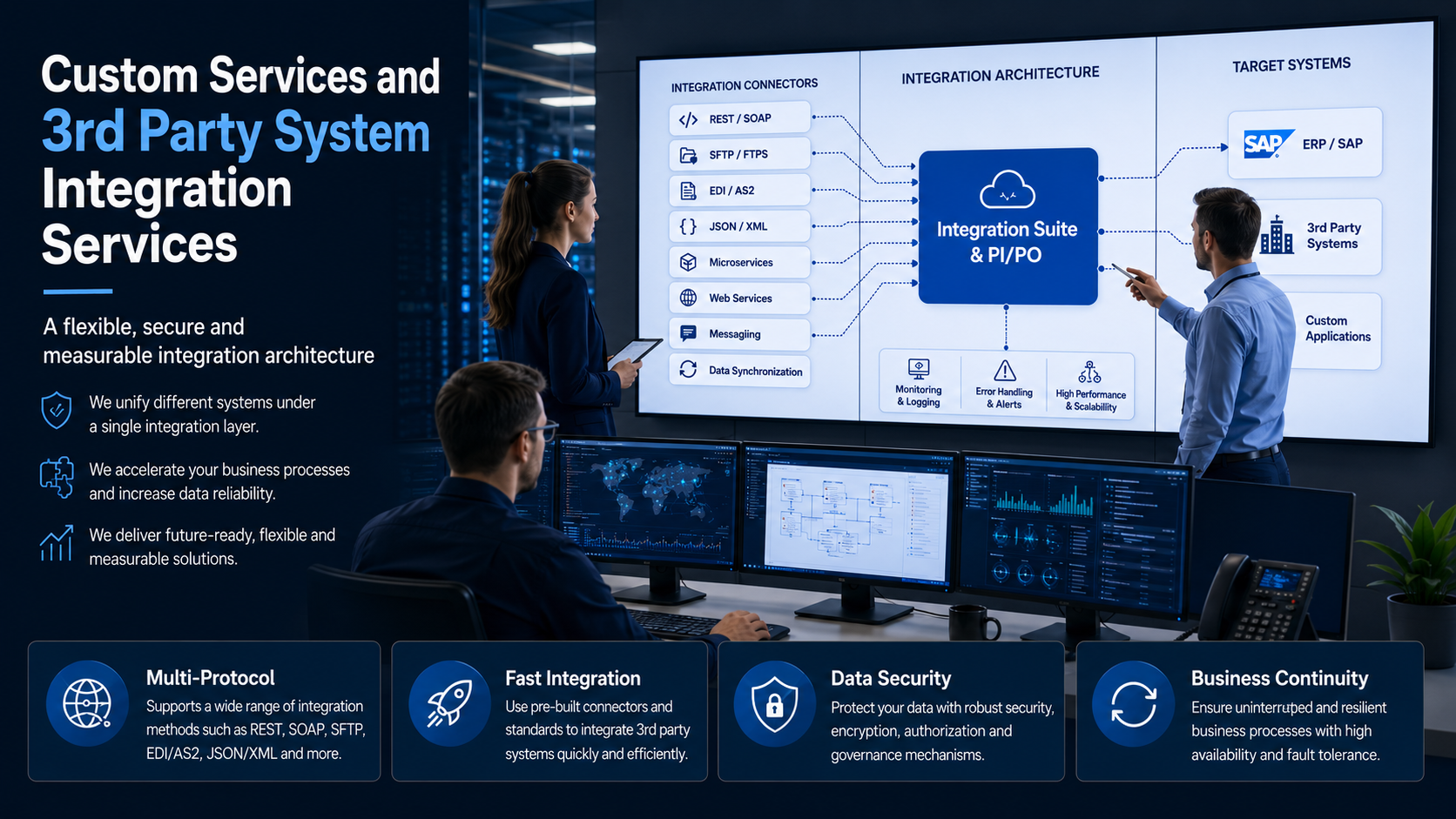
THIRD-PARTY INTEGRATION PACKAGE
3RDPARTY INTEGRATION PACKAGES Flexible and scalable integration solutions with different protocols and methodologies through Integration Suite & PI/PO Short Description Our custom services and 3rdParty system integration services enable secure, flexible and sustainable data flow between SAP systems and different external systems, applications and services. Through the Integration Suite & PI/PO infrastructure, scalable integration solutions are provided between ERP/SAP, 3rdParty systems, CRM, mobile applications and reporting platforms by supporting different integration methods such as REST, SOAP, SFTP/FTPS, EDI/AS2, JSON/XML and event-driven architecture. Solution Overview This solution is designed to create a common integration layer between SAP systems and custom-developed services, 3rdParty applications and different technology infrastructures beyond standard packaged integrations. The Integration Suite & PI/PO structure centrally manages both inbound and outbound data flows, provides transformation between different protocols and helps business processes progress in a more controlled, traceable and scalable way. Supported Integration Methods and Use Cases Integration Method Purpose of Use Example Target / Use Case REST / SOAP Service-based data exchange and transaction triggering between systems. ERP/SAP, CRM, custom services, external applications SFTP / FTPS Secure file-based data transfer. Batch data flows, file sharing, report transfers EDI / AS2 Secure and rule-based transmission of standard business documents. Business partners, suppliers, external platforms JSON / XML Transformation and integration between different data formats. APIs, microservices, application services API / REST Real-time transaction and data service usage. Mobile applications, web applications, 3rdParty services Event-Driven Real-time integration setup with event-based flows. Notifications, trigger processes, asynchronous flows Microservices / Web Services Integration with modular and flexible architectures. Custom business services, organization-specific applications Data Synchronization Maintaining consistent data freshness between different systems. Customer, product, order, stock and reference data Main Integration Components Central Integration Layer: All protocol, transformation and routing processes are managed from a single center with the Integration Suite & PI/PO structure. Target Systems: Connections can be established with ERP/SAP, 3rdParty systems, CRM, mobile applications and reporting environments. Traceability and Logging: Operational tracking is strengthened with real-time monitoring, detailed logging and process visibility. Error Management and Alerts: Monitoring, alerting and intervention mechanisms are supported for possible integration errors. Load Balancing and Scalability: A flexible architecture approach is provided that adapts to increasing transaction volumes. Benefits Provided It brings different systems and integration methods together under a single structure. It accelerates business processes while making data flow more secure and controlled. It offers a flexible architecture that adapts more quickly to new system or service needs. It provides operational visibility with real-time monitoring, logging and error management. Thanks to its scalable structure, it provides sustainable integration support for increasing transaction volumes.